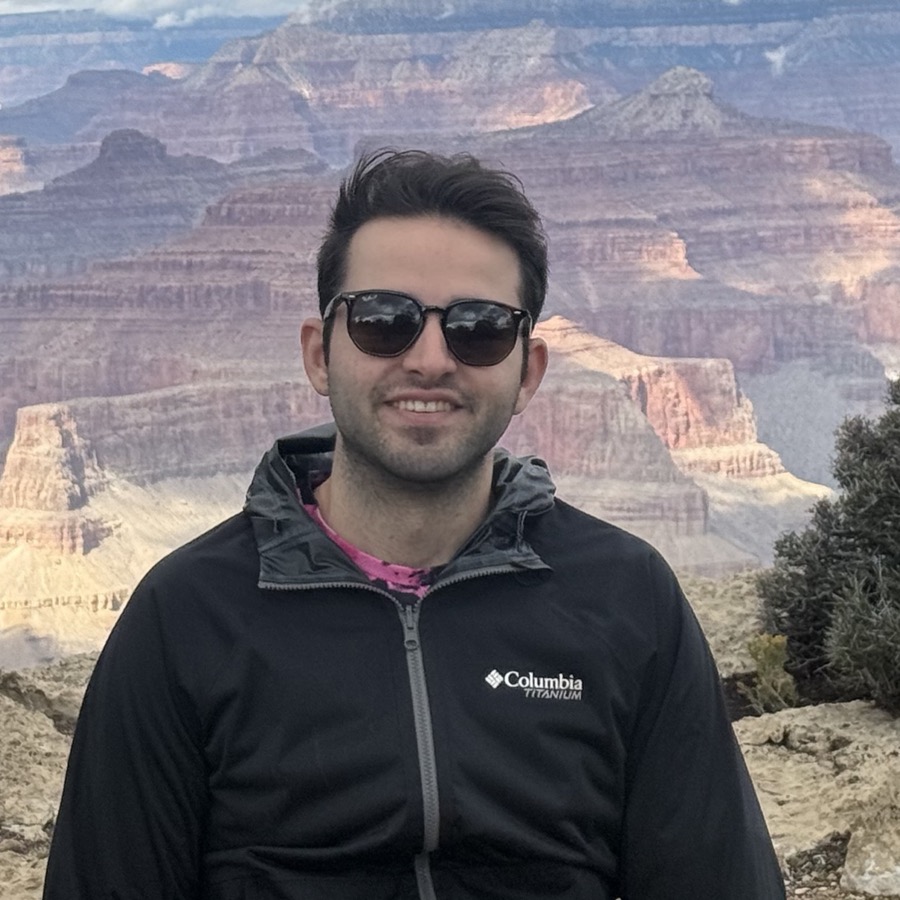
Batu Ozturkler at the Grand Canyon

Batu Ozturkler

Senior Research Scientist, Microsoft CodeAI

Hello! I am a Senior Research Scientist at Microsoft CodeAI. I work on learned agent orchestration for GitHub Copilot Fusion, building reinforcement learning environments and training coordinator models for long-horizon coding tasks.

Previously, I worked on multilingual training and synthetic-data generation for GPT-4o, scalable evaluation, and calibrated confidence estimation in language and vision-language models.

I received my Ph.D. in Electrical Engineering from Stanford University, where I was an NSF Graduate Research Fellow advised by John Pauly and Mert Pilanci. My doctoral work covered probabilistic reasoning with LLMs, diffusion models, robust and memory-efficient learning, and medical imaging.

Research interests: learned agent orchestration, LLM post-training and evaluation, calibrated confidence, probabilistic reasoning, and AI for scientific research.

Outside of research, I enjoy tennis, soccer, hiking, and an overly competitive game of pool.

Experience

Microsoft / CodeAI

Senior Research Scientist

Aug 2026 – Present

Research Scientist II

Mar 2026 – Jul 2026

  • Built a reinforcement learning environment combining a coding-agent harness and user simulator to generate multi-turn rollouts and rewards. Trained small coordinator LLMs to compose tool-using workflows and route steps across models for GitHub Copilot Fusion.
  • At its max setting in Copilot CLI, the released system performed within approximately two index points of Claude Code with Opus 5.5 (max), at 51% lower API cost per task, on the Artificial Analysis Coding Agent Index v2.0 (October 2026).
  • Led development of a fine-tuned ModernBERT credential scanner deployed at the scale of all GitHub push traffic. Improved precision over multi-LLM workflows by over 11.5% in online A/B tests, while reducing inference cost by over 98% and latency by over 86%. GitHub blog.

Applied Scientist II

May 2024 – Feb 2026

  • Co-developed multilingual training for GPT-4o across mid-training, SFT, DPO, and RLHF; built large-scale benchmarks, scalable evaluation pipelines, and synthetic-data generation systems.
  • Developed calibrated confidence estimation using auxiliary predictors and RL-based post-training with calibrated rewards, improving hallucination detection by 10% AUROC in production systems, including vision-language models for structured extraction from long documents.
  • Designed tool-calling, retrieval, and search workflows for Azure AI Foundry Agents and improved response latency by 30% without reducing quality.

Stanford University

Postdoctoral Scholar

Mar 2024 – May 2024

Research Assistant

Sep 2019 – Jan 2024

  • Developed memory-efficient training methods and self-supervised augmentation for robust MRI reconstruction.
  • Developed equivalent convex formulations of non-convex neural networks with robustness, interpretability, and convergence guarantees.

Research internships

NVIDIA · Research Intern

Sep 2022 – Apr 2023

Improved the robustness and efficiency of diffusion models for MRI reconstruction under distribution shifts using SURE and variational inference, with Chao Liu and Jan Kautz.

Microsoft Research · Research Intern

Jun 2022 – Aug 2022

Developed probabilistic inference methods for LLM reasoning and studied prompt sensitivity and in-context learning failures, under the supervision of Nebojsa Jojic.

ETH Zürich · Research Intern

Jun 2018 – Aug 2018

Worked on ultrasound imaging in the Computer Vision Lab with Orcun Goksel.

Selected publications

Google Scholar
  1. ThinkSum: Probabilistic Reasoning over Sets Using Large Language Models.
    B. Ozturkler, N. Malkin, Z. Wang, N. Jojic. ACL 2023.

    Paper
  2. SMRD: SURE-based Robust MRI Reconstruction with Diffusion Models.
    B. Ozturkler, C. Liu, B. Eckart, M. Mardani, J. Song, J. Kautz. MICCAI 2023, early accept (top 15%).

    Paper
  3. RED-diff: Regularization by Denoising Diffusion Process for MRI Reconstruction.
    B. Ozturkler, M. Mardani, A. Vahdat, J. Kautz, J. Pauly. NeurIPS 2023 Workshop on Deep Learning and Inverse Problems.

    Paper
  4. Unraveling Attention via Convex Duality: Analysis and Interpretations of Vision Transformers.
    A. Sahiner, T. Ergen, B. Ozturkler, J. Pauly, M. Mardani, M. Pilanci. ICML 2022.

    Paper
  5. VORTEX: Physics-Driven Data Augmentations for Consistency Training for Robust Accelerated MRI Reconstruction.
    A. D. Desai, B. Gunel, B. M. Ozturkler, H. Beg, S. Vasanawala, B. A. Hargreaves, C. Ré, J. M. Pauly, A. S. Chaudhari. MIDL 2022, Best Paper Award.

    Paper
  6. Demystifying Batch Normalization in ReLU Networks: Equivalent Convex Optimization Models and Implicit Regularization.
    T. Ergen, A. Sahiner, B. Ozturkler, J. M. Pauly, M. Mardani, M. Pilanci. ICLR 2022.

    Paper

Education

Stanford University

Ph.D. in Electrical Engineering · GPA 3.99/4.00

2019 – 2024

Advisors: John Pauly and Mert Pilanci. Thesis: Efficient and robust deep learning for medical imaging and natural language processing.

Stanford University

M.S. in Electrical Engineering · GPA 3.99/4.00

2019 – 2021

Middle East Technical University

B.S. in Electrical Engineering · GPA 3.96/4.00 · Rank 3/413

2015 – 2019

Honors

  • NSF Graduate Research Fellowship
  • Stanford EE Departmental Fellowship

Service

Reviewer for ACL, NeurIPS, ICML, ICLR, MICCAI, and IEEE Transactions on Medical Imaging.

Program Committee, ICML Workshop on Knowledge and Logical Reasoning.